The story
Its key moments
Where it sits in time
Five thousand years, 3000 BCE to 2026; the state in gold.
State · South Asia
1559 – 1768 · 209 years
Its ground peaked in 1762 at 149,200 km².↓ Its highest office was held by 10 rulers, covering 1559 – 1768, the median reign 20.5 years; none of its 9 handovers was irregular.↓ Among them,  Prithvi Narayan Shah, Dravya Shah and Chatra Shah are the best known.↓ The atlas files 9 rows under it, most of them people.↓ It ended in 1768, 209 years after it began.↑
209 years
Longer than Greenland, shorter than the Achaemenid Empire
149,000 km²
At its height in 1762 · about the size of Nepal
10 rulers
the monarch
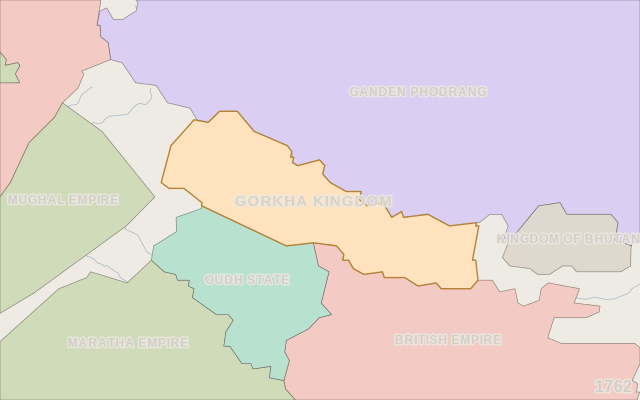
 British Empire,
 Maratha Empire,
 Mughal Empire,
 Oudh State and
 Durrani Empire.How far it reached, year by year: its ground inside the borders Cliopatria draws (CC BY 4.0), measured on an equal-area grid; the map shows it at its largest, with the cities of the year.
The story
Five thousand years, 3000 BCE to 2026; the state in gold.
Its people
One axis for everyone, so you can see who knew whom: the best-known, ordered by birth.
 Ram Shahmonarch1606 – 1636
How it was governed
10 monarchs on record, 1559 to 1768; a reign lasted 20.5 years at the median. Each bar is a reign, as long as it lasted.
The line of monarch.
| Ruler | Reign | Length | How it ended · source | To the ruler before |
|---|---|---|---|---|
| 16th century · 2 reigns | ||||
| Dravya Shah | 1559 – 1570 | 11 years | ending not on record | |
| Purna Shah | 1570 – 1605 | 35 years | ending not on record | child |
| 17th century · 6 reigns | ||||
| Chatra Shah | 1605 – 1606 | 1 year | ending not on record | child |
| Ram Shah | 1606 – 1636 | 30 years | ending not on record | sibling |
| Dambar Shah | 1636 – 1645 | 9 years | ending not on record | child |
| Krishna Shah | 1645 – 1661 | 16 years | ending not on record | child |
| Rudra Shah | 1661 – 1673 | 12 years | ending not on record | child |
| Prithvipati Shah | 1673 – 1716 | 43 years | ending not on record | child |
| 18th century · 2 reigns | ||||
| Nara Bhupal Shah | 1716 – 1743 | 27 years | ending not on record | grandchild |
 Prithvi Narayan Shah · aged 20 | 1743 – 1768 | 25 years | left office aliveread off the dates alonedied of natural causes | child |
10 rulers, 10 with terms dated as terms, covering 1559 – 1768. Median reign 20.5 years. 0 of 9 handovers irregular - a killing, a deposition, a rival claimant, a rising or a coup beside it. A blank in the last column means no kin on record, which is coverage, never “unrelated”.
Ram Shah30 yrsPrithvi Narayan Shah25 yrsIts world
The best-known states of other regions that stood while it did; the band is the Gorkha kingdom’s own years.
 SwedenEurope
 Ottoman EmpireMiddle East and North Africa
 BruneiEast and Southeast Asia
 JoseonEast and Southeast Asia
 HaudenosauneeAmericas and Oceania
 SpainEurope
 MoroccoMiddle East and North Africa
 DahomeySub-Saharan Africa
How it compares
Each column is a share of the states; gold is the Gorkha kingdom.
Why it fell
Historians still argue. Here is what the atlas records about its last century:
Wars and battles in red, risings, coups and massacres beside them, everything else in grey, by the century each began in. A tall bar is partly a fact about Wikipedia: better-documented centuries hold more.
Each century’s own page:1500 – 15991600 – 16991700 – 1799
“Gorkha kingdom”, Pastlas, a historical atlas, 2026-11-26. https://app.pastlas.com/state/gorkha-kingdom/
Drawn from Wikidata (Q3332217, CC0), borders from Cliopatria (CC BY 4.0), coast and rivers from Natural Earth, cities from Reba, Reitsma & Seto 2016 (CC BY 4.0). Data built 2026-11-26 · Pastlas v2.47.1, by Oleh Voronko; the published atlas and its data are for non-commercial use.
Areas are measured on an equal-area grid from borders simplified to about five kilometres. “c.” marks an approximate date, and a date known to the century is never printed to the year. Counts are what the atlas holds, and they follow Wikipedia’s coverage: a busy century is partly a fact about the record.