State · South Asia

Ghaznavid Empire

962 – 1187 · 225 years

Came after Saffarid State

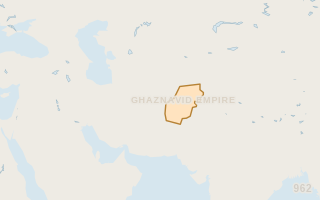
It was founded in 962, replacing Saffarid State.↓ In 962, the first year its borders are mapped, it covered 296,900 km².↓

Continue reading

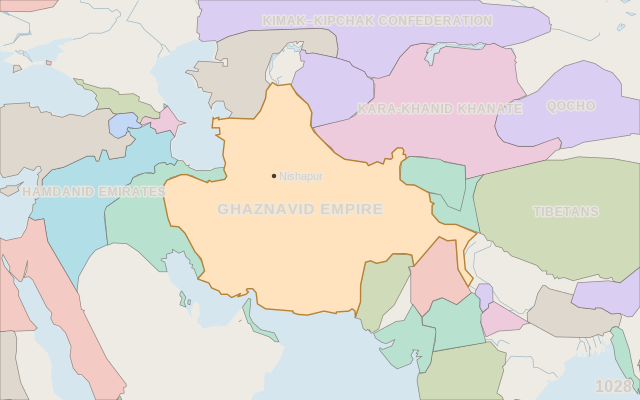
It reached its greatest extent in 1028: 3.00 million km².↓ Its line counts 17 rulers, covering 997 – 1186, the median reign 7 years; 6 of 16 handovers were irregular.↓ Among them, Mahmud of Ghazni, Masʽud I and Muhammad of Ghazni are the best known.↓ The atlas files 21 rows under it, most of them people.↓ It ended in 1187, 225 years after it began.↑

225 years

Longer than the Achaemenid Empire, shorter than the Polish–Lithuanian Commonwealth

3.0 million km²

At its height in 1028 · about the size of India

17 rulers

the Sultan of the Ghaznavid Empire

2 wars and battles

21 entries in all

Map: Ghaznavid Empire in 1028, its borders in gold among its neighbours
1000105011001150
Beside it on the map in 1028: Kara-Khanid Khanate, Tibetans, Kimak–Kipchak confederation, Hamdanid dynasty, Qocho and Fatimid Caliphate.How far it reached, year by year: its ground inside the borders Cliopatria draws (CC BY 4.0), measured on an equal-area grid; the map shows it at its largest, with the cities of the year.

The story

Its key moments

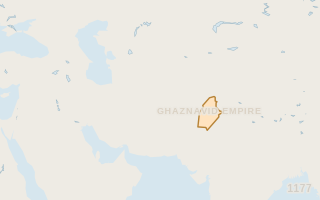
Ghaznavid Empire in 1177, last mappedGhaznavid Empire in 962, first mapped
The rise and the fall in one frame: drag across it from 962, first mapped at 296,900 km², to 1177, last mapped at 146,500 km². Open the live map in 962 or 1177.

Before and after

Before it

  • Saffarid State · replaces

Where it sits in time

3000 BCE2000 BCE1000 BCE110002000Ghaznavid Empire: 962 – 1187

Five thousand years, 3000 BCE to 2026; the state in gold.

Its people

Lives across the Ghaznavid Empire

1000105011001150
Statesmen and generalsLived on after it endedAll its people on the timeline →

How it was governed

17 sultans

17 sultans on record, 997 to 1186; a reign lasted 7 years at the median. Each bar is a reign, as long as it lasted.

Ismail of Ghazni · 997 – 998 · no death date to read the end againstMahmud of Ghazni · 998 – 1030 · died in office, manner not recordedMuhammad of Ghazni · 1030 – 1041 · died in office, manner not recordedMasʽud I · 1030 – 1041 · died in office, manner not recordedMawdud of Ghazni · 1041 – 1048 · left office aliveMasud II · 1048 – 1048 · left office aliveAli of Ghazna · 1048 – 1049 · left office aliveAbd al-Rashid ben Mahmud · 1049 – 1052 · died in office, manner not recordedToghrul of Ghazna · 1052 – 1053 · executedFarrukh-Zad of Ghazna · 1053 – 1059 · died in office, manner not recordedIbrahim of Ghazna · 1059 – 1099 · died in office, manner not recordedMas'ud III of Ghazni · 1099 – 1115 · died in office, manner not recordedArslan-Shah of Ghazna · 1114 – 1117 · left office aliveShir-Zad of Ghazna · 1115 – 1116 · deposed, the article saysBahram-Shah of Ghazna · 1117 – 1152 · died in office, manner not recordedKhusrau Shah of Ghazna · 1152 – 1160 · died in office, manner not recordedKhusrau Malik · 1160 – 1186 · left office alive1000105011001150
a second row: a reign that began before the last had ended — rival claimants, or a shared throne
How their terms ended, where it is known (16 of 17):Killed 1Deposed or removed 1Died in office 9Left office alive 5Not on record 1
Every term, with how it ended and its source

Rulers

How 17 reigns ended - choose one to show only those

How they died, where the record says: died of natural causes 1 · executed 1.

RulerReignLengthHow it ended · sourceTo the ruler before
10th century · 2 reigns
Ismail of Ghazni · aged 27997 – 9981 yearending not on record
Mahmud of Ghazni · aged 27998 – 103032 yearsdied in officeread off the dates alonesibling
11th century · 10 reigns · 1 killed or removed
Muhammad of Ghazni · aged 321030 – 104111 yearsdied in officeread off the dates alonechild
Masʽud I · aged 321030 – 104111 yearsdied in officeread off the dates alonesibling
Mawdud of Ghazni · aged 291041 – 10487 yearsleft office aliveread off the dates alonedied of natural causeschild
Masud II · aged 71048 – 1048under a yearleft office aliveread off the dates alonechild
Ali of Ghazna · aged 281048 – 10491 yearleft office aliveread off the dates alone
Abd al-Rashid ben Mahmud · aged 261049 – 10523 yearsdied in officeread off the dates alone
Toghrul of Ghazna1052 – 10531 yearexecutedWikidata's manner of death
Farrukh-Zad of Ghazna · aged 281053 – 10596 yearsdied in officeread off the dates alone
Ibrahim of Ghazna · aged 271059 – 109940 yearsdied in officeread off the dates alonesibling
Mas'ud III of Ghazni · aged 381099 – 111516 yearsdied in officeread off the dates alonechild
12th century · 5 reigns · 1 killed or removed
Arslan-Shah of Ghazna · aged 221114 – 11173 yearsleft office aliveread off the dates alonechild
Shir-Zad of Ghazna · aged 251115 – 11161 yeardeposedread from the ruler's own articlesibling
Bahram-Shah of Ghazna · aged 331117 – 115235 yearsdied in officeread off the dates alonesibling
Khusrau Shah of Ghazna · aged 311152 – 11608 yearsdied in officeread off the dates alonechild
Khusrau Malik · aged 201160 – 118626 yearsleft office aliveread off the dates alonechild

17 rulers, 17 with terms dated as terms, covering 997 – 1186. Median reign 7 years. 6 of 16 handovers irregular - a killing, a deposition, a rival claimant, a rising or a coup beside it. A blank in the last column means no kin on record, which is coverage, never “unrelated”.

Its world

Who else stood

Meanwhile, elsewhere

The best-known states of other regions that stood while it did; the band is the Ghaznavid Empire’s own years.

95010001050110011501200

How it compares

Among 3,073 states

Stood longer than 66% of 3,073 states
Ghaznavid Empire · 225 yearsAchaemenid EmpirePolish–Lithuanian CommonwealthHow long it stood, among the states with a recorded end or still standing.
Held more ground at its peak than 95% of 1,464 states
Ghaznavid Empire · 2,996,300 km²ArgentinaIndiaThe most ground it held, among the states with a border in Cliopatria.

Why it fell

Why did the Ghaznavid Empire fall?

Historians still argue. Here is what the atlas records about its last century:

÷8.5

its land, between 1087 and 1186

1116

Shir-Zad of Ghazna, deposed or removed in office

What led to it, and what came of it

Saffarid State · Linked · 861 – 900Saffarid StateFerdowsi · Coincidence · 940 – 1020FerdowsiSabuktigin · Coincidence · 942 – 997SabuktiginGhaznavid Empire · 962 – 1187Ghaznavid Empire900100011001200
linkedcoincidence

Open the investigation: every row with its evidence, the conditions at the time, the theories condition by condition, and the succession analysed.

Its centuries in the record

900 – 999: 5 recorded — 1 wars and battles, 0 risings, regime changes and massacres, 4 other9001000 – 1099: 14 recorded — 1 wars and battles, 0 risings, regime changes and massacres, 13 other10001100 – 1199: 2 recorded — 0 wars and battles, 0 risings, regime changes and massacres, 2 other1100

Wars and battles in red, risings, coups and massacres beside them, everything else in grey, by the century each began in. A tall bar is partly a fact about Wikipedia: better-documented centuries hold more.

Each century’s own page:900 – 9991000 – 10991100 – 1199

Keep exploring

Share this page
Copy link
Embed the map
Cite this page

How this page is made

Drawn from Wikidata (Q249578, CC0), borders from Cliopatria (CC BY 4.0), coast and rivers from Natural Earth, cities from Reba, Reitsma & Seto 2016 (CC BY 4.0). Data built 2026-11-26 · Pastlas v2.47.1, by Oleh Voronko; the published atlas and its data are for non-commercial use.

How to read it

Areas are measured on an equal-area grid from borders simplified to about five kilometres. “c.” marks an approximate date, and a date known to the century is never printed to the year. Counts are what the atlas holds, and they follow Wikipedia’s coverage: a busy century is partly a fact about the record.

Something wrong?

Tell us and name the entry. We fix the data, not just this page.

Report a problem