 Mohammad Daoud Khan and Abdul Qadir.
1973 Afghan coup d'état
adverse regime change · 17 July 1973
State · South Asia
1973 – 1978 · 5 years
Came after  Kingdom of Afghanistan · became Democratic Republic of Afghanistan
The Republic of Afghanistan began in 1973, replacing the Kingdom of Afghanistan.↓ When the borders dataset first draws it, in 1973, it held 644,100 km².↓
Best known for
5 years
Longer than the Confederate States of America, shorter than Freetown
644,000 km²
At its height in 1973 · about the size of Afghanistan
2 rulers
the head of state
1 war or battle
More per century than 92% of states · 7 entries in all
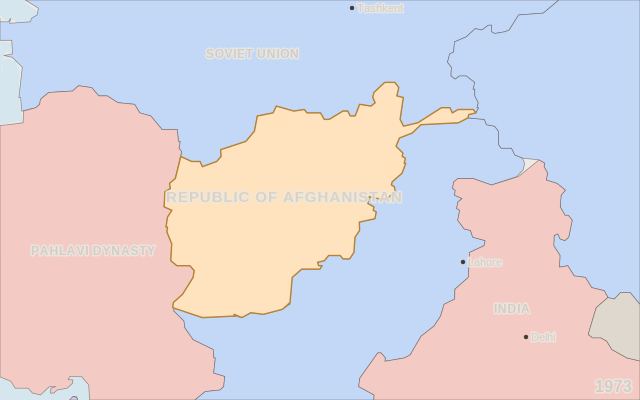
 Soviet Union,
 Pahlavi Iran,
 Pakistan,
 People's Republic of China,
 India and
 Kingdom of Nepal.How far it reached, year by year: its ground inside the borders Cliopatria draws (CC BY 4.0), measured on an equal-area grid; the map shows it at its largest, with the cities of the year.
The story
The best-known wars, battles, risings and changes of regime the record files under it; a war within a war is folded into it.
adverse regime change · 17 July 1973
unrest · 27 April 1978
war · 27 April 1978
The states the record files it as replacing or following, and those that replaced or followed it - Wikidata's own statements, each read from this state's side.
Kingdom of Afghanistan · replaces · 1926 – 1973Five thousand years, 3000 BCE to 2026; the state in gold, what it replaced or followed and what replaced or followed it in grey.
Its people
One axis for everyone, so you can see who knew whom: the best-known, ordered by birth.
The best-known people the record files under it, by how many Wikipedias write about them.
 Mohammad Daoud Khanruler · 1909 – 1978
 Zabihullah Mujahidperson · born 1978, living
How it was governed
2 heads on record, 1973 to 1978. Each bar is a reign, as long as it lasted.
The line of head of state.
| Ruler | Reign | Length | How it ended · source | To the ruler before |
|---|---|---|---|---|
| 20th century · 2 reigns · 1 killed or removed | ||||
| Mohammad Daoud Khan | 1973 – 1978 | 5 years | deposedread from the ruler's own articlekilled | |
| Abdul Qadir | 1978 – 1978 | under a year | ending not on recorddied of natural causes | |
2 rulers, 2 with terms dated as terms, covering 1973 – 1978. Only 5 years of the line are dated - too short for a median. 1 of 1 handovers irregular - a killing, a deposition, a rival claimant, a rising or a coup beside it. The violent-handover count is withheld: power changed hands so often that any rising falls beside one (exposure 1.00, limit 0.6). A blank in the last column means no kin on record, which is coverage, never “unrelated”.
Each symbol with the years its own statement gives; the timeline flies the one of the year on screen.

How it compares
Each column is a share of the states; gold is the Republic of Afghanistan.
Why it fell
Historians still argue. Here is what the atlas records about its last century:
1978
Mohammad Daoud Khan, deposed or removed in office
The investigation's own picture: 1 cause the record names and 1 result, the strongest six of each at their own years, joined to the state by the kind of claim - a recorded statement solid, the article's sentence dashed, a theory dash-dot.
Open the investigation: every row with its evidence, the conditions at the time, the theories condition by condition, and the succession analysed.
7 entries the atlas files under it, all in 1900 – 1999.
“Republic of Afghanistan”, Pastlas, a historical atlas, 2026-11-26. https://app.pastlas.com/state/republic-of-afghanistan/
Drawn from Wikidata (Q1415128, CC0), borders from Cliopatria (CC BY 4.0), coast and rivers from Natural Earth, cities from Reba, Reitsma & Seto 2016 (CC BY 4.0), symbols from Wikimedia Commons, each under its own licence. Data built 2026-11-26 · Pastlas v2.47.1, by Oleh Voronko; the published atlas and its data are for non-commercial use.
Areas are measured on an equal-area grid from borders simplified to about five kilometres. “c.” marks an approximate date, and a date known to the century is never printed to the year. Counts are what the atlas holds, and they follow Wikipedia’s coverage: a busy century is partly a fact about the record.