Dynasty · South Asia
Lodi dynasty
1451 – 1526 · 75 years
Continue readingShow less
Its ground peaked in 1497 at 442,300 km².↓ Its line counts 3 rulers, covering 1451 – 1526, the median reign 28 years; none of its 2 handovers was irregular.↓ The best known of them are  Ibrahim Khan Lodi,
 Bahlul Khan Lodi and
 Sikandar Khan Lodi.↓ Most of the 4 rows the atlas files under it are people.↓
Its own article says it was dissolved, in 1526.↓
Best known for
75 years
Longer than Yugoslavia, shorter than the Empire of Japan
442,000 km²
At its height in 1497 · about the size of Iraq
3 rulers
the Sultan of Hindustan (Sultan of Delhi)
1 war or battle
4 entries in all
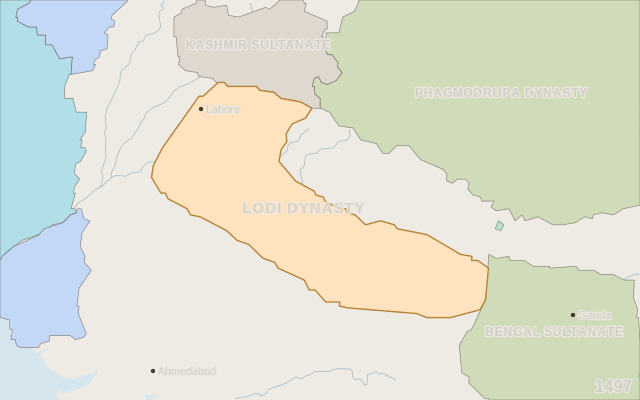
 Bengal Sultanate,
 Timurid Empire, Kashmir Sultanate, Samma dynasty and
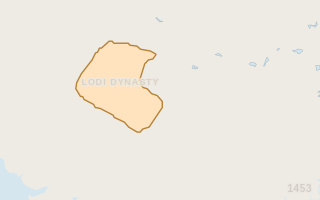
 Kathmandu.How far it reached, year by year: its ground inside the borders Cliopatria draws (CC BY 4.0), measured on an equal-area grid; the map shows it at its largest, with the cities of the year.
Its people
Lives across the Lodi dynasty
One axis for everyone, so you can see who knew whom: the best-known, ordered by birth.
Notable figures
The best-known people the record files under it, by how many Wikipedias write about them.
 Guru Nanakreligious leader · 1469 – 1539
 Hemuperson · 1501 – 1556
- Pir Roshanwriter · 1525 – 1573
How it was governed
3 sultans
3 sultans on record, 1451 to 1526; a reign lasted 28 years at the median. Each bar is a reign, as long as it lasted.
Every term, with how it ended and its source
Rulers
The line of Sultan of Hindustan (Sultan of Delhi).
| Ruler | Reign | Length | How it ended · source | To the ruler before |
|---|---|---|---|---|
| 15th century · 2 reigns | ||||
 Bahlul Khan Lodi · aged 51 | 1451 – 1489 | 38 years | died in officeread off the dates alone | |
 Sikandar Khan Lodi · aged 31 | 1489 – 1517 | 28 years | died in officeread off the dates alone | child |
| 16th century · 1 reign · 1 killed or removed | ||||
 Ibrahim Khan Lodi · aged 37 | 1517 – 1526 | 9 years | died in battleWikidata's manner of death | child |
3 rulers, 3 with terms dated as terms, covering 1451 – 1526. Median reign 28 years. 0 of 2 handovers irregular - a killing, a deposition, a rival claimant, a rising or a coup beside it. A blank in the last column means no kin on record, which is coverage, never “unrelated”.
Longest reigns
- Bahlul Khan Lodi38 yrs
- Sikandar Khan Lodi28 yrs
- Ibrahim Khan Lodi9 yrs
Its world
Who else stood
Meanwhile, elsewhere
The best-known states of other regions that stood while it did; the band is the Lodi dynasty’s own years.
- Maya civilizationAmericas and Oceania
 Persian EmpireMiddle East and North Africa
 DenmarkEurope
 SwedenEurope
- Mali EmpireSub-Saharan Africa
 Ottoman EmpireMiddle East and North Africa
 BruneiEast and Southeast Asia
 Ming dynastyEast and Southeast Asia
How it compares
Among 3,073 states
Each column is a share of the states; gold is the Lodi dynasty.
Why it fell
Why did the Lodi dynasty fall?
Historians still argue. Here is what the atlas records about its last century:
1
wars and battles in its last century, more than in any before it
1526
Ibrahim Khan Lodi, killed in office
How it ended, as its article says
Dissolved. Read from the article's section “Fall of the empire” by its grammar; the claim is only that the article says so.
With the death of Ibrahim Lodi, the Lodi dynasty also came to an end, leading to the establishment of the Mughal Empire in the subcontinent.
One sentence of the English Wikipedia article, CC BY-SA 4.0.
Its centuries in the record
Wars and battles in red, risings, coups and massacres beside them, everything else in grey, by the century each began in. A tall bar is partly a fact about Wikipedia: better-documented centuries hold more.
Each century’s own page:1400 – 14991500 – 1599
Keep exploring
Copy link
Embed the map
Cite this page
“Lodi dynasty”, Pastlas, a historical atlas, 2026-11-26. https://app.pastlas.com/state/lodi-dynasty/
How this page is made
Drawn from Wikidata (Q11709, CC0), borders from Cliopatria (CC BY 4.0), coast and rivers from Natural Earth, cities from Reba, Reitsma & Seto 2016 (CC BY 4.0), and one sentence of the article, quoted. Data built 2026-11-26 · Pastlas v2.47.1, by Oleh Voronko; the published atlas and its data are for non-commercial use.
How to read it
Areas are measured on an equal-area grid from borders simplified to about five kilometres. “c.” marks an approximate date, and a date known to the century is never printed to the year. Counts are what the atlas holds, and they follow Wikipedia’s coverage: a busy century is partly a fact about the record.