The story
Its key moments
Where it sits in time
Five thousand years, 3000 BCE to 2026; the state in gold.
State · Middle East and North Africa
1011 – 1145 · 134 years
134 years
Longer than Nizhny Novgorod, shorter than the Maurya Empire
5,000 km²
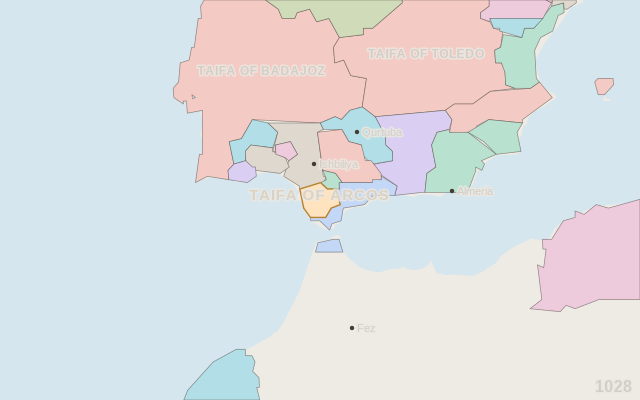
At its height in 1028
The story
Five thousand years, 3000 BCE to 2026; the state in gold.
Its world
The best-known states of other regions that stood while it did; the band is the Taifa of Arcos’s own years.
 DenmarkEurope
 TibetansSouth Asia
 SwedenEurope
 Kilwa SultanateSub-Saharan Africa
How it compares
Each column is a share of the states; gold is the Taifa of Arcos.
Why it fell
Historians still argue. Here is what the atlas records about its last century:
The investigation's own picture: 16 causes the record names and 0 results, the strongest six of each at their own years, joined to the state by the kind of claim - a recorded statement solid, the article's sentence dashed, a theory dash-dot.
Open the investigation: every row with its evidence, the conditions at the time, the theories condition by condition, and the succession analysed.
Of 5 theories of why states fall, 1 has every condition present at this ending; each is applied by its own logic, condition by condition, and whether its authors named this case is a footnote.
Ibn Khaldun 1377 · Turchin & Nefedov 2009
Applies by its own logic: the condition it names held here, and this is the kind of outcome it predicts — adverse regime change or the state's ending.
“Taifa of Arcos”, Pastlas, a historical atlas, 2026-11-26. https://app.pastlas.com/state/taifa-of-arcos/
Drawn from Wikidata (Q2390604, CC0), borders from Cliopatria (CC BY 4.0), coast and rivers from Natural Earth, cities from Reba, Reitsma & Seto 2016 (CC BY 4.0). Data built 2026-11-26 · Pastlas v2.47.1, by Oleh Voronko; the published atlas and its data are for non-commercial use.
Areas are measured on an equal-area grid from borders simplified to about five kilometres. “c.” marks an approximate date, and a date known to the century is never printed to the year. Counts are what the atlas holds, and they follow Wikipedia’s coverage: a busy century is partly a fact about the record.