State · Europe

Kingdom of Italy (Napoleonic)

1805 – 1814 · 9 years

Came after Italian Republic

Its record opens in 1805, after the Italian Republic.↓ In 1806, the first year its borders are mapped, it covered 47,100 km².↓

Continue reading

It reached its greatest extent in 1811: 84,800 km².↓ Its line names a single ruler, covering 1805 – 1814.↓ It ended in 1814, 9 years after it began.↑

9 years

Longer than Freetown, shorter than Nazi Germany

84,800 km²

At its height in 1811 · about the size of Austria

1 ruler

the King

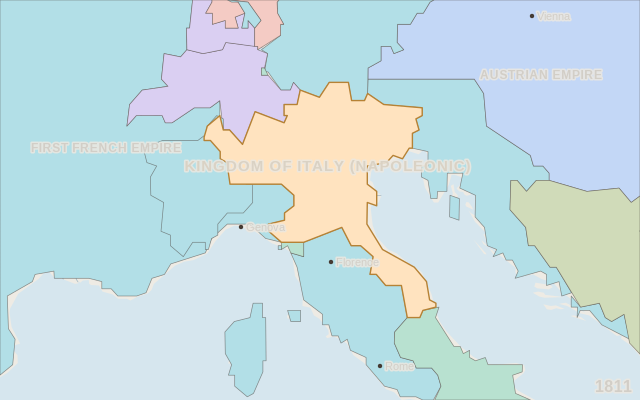
Map: Kingdom of Italy (Napoleonic) in 1811, its borders in gold among its neighbours
Beside it on the map in 1811: First French Empire, Austrian Empire, Ottoman Empire, Kingdom of Bavaria, Helvetic Republic and Kingdom of Sardinia (1720–1861).How far it reached, year by year: its ground inside the borders Cliopatria draws (CC BY 4.0), measured on an equal-area grid; the map shows it at its largest, with the cities of the year.

The story

Its key moments

Before and after

Before it

Where it sits in time

3000 BCE2000 BCE1000 BCE110002000Italian Republic: 1802 – 1805Kingdom of Italy (Napoleonic): 1805 – 1814

Five thousand years, 3000 BCE to 2026; the state in gold, what it replaced or followed and what replaced or followed it in grey.
How it was governed

Its rulers

1 king on record, 1805 to 1814. Each bar is a reign, as long as it lasted.

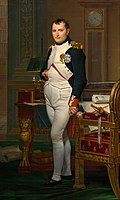
Napoleon · 1805 – 1814 · no death date to read the end against18061808181018121814
How their terms ended, where it is known (0 of 1):Not on record 1
Every term, with how it ended and its source

Rulers

RulerReignLengthHow it ended · sourceTo the ruler before
19th century · 1 reign
Napoleon1805 – 18149 yearsending not on recorddied of natural causes

1 ruler, 1 with terms dated as terms, covering 1805 – 1814. Only 9 years of the line are dated - too short for a median. A blank in the last column means no kin on record, which is coverage, never “unrelated”.

Flags and arms, in order

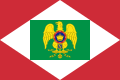
  • Flag of the Napoleonic Kingdom of Italy
    flag, undatedFlag of the Napoleonic Kingdom of Italy · CC BY-SA 3.0 · Sodacan
  • Great Coat of Arms of the Kingdom of Italy (1805-1814)
    coat of arms, undatedGreat Coat of Arms of the Kingdom of Italy (1805-1814) · CC BY-SA 4.0 · FDRMRZUSA . See related sourced file (file history) for original author (User: SODACAN) .
  • Coat of Arms of the Kingdom of Italy (1805-1814)
    coat of arms, undatedCoat of Arms of the Kingdom of Italy (1805-1814) · CC BY-SA 3.0 · Sodacan

Its world

Rivals, and who else stood

Who it fought most

Wars and battles both took part in, on whichever side: the record names who took part, not who fought whom.

How it compares

Among 3,073 states

Stood longer than 16% of 3,073 states
Kingdom of Italy (Napoleonic) · 9 yearsFreetownNazi GermanyHow long it stood, among the states with a recorded end or still standing.
Held more ground at its peak than 41% of 1,464 states
Kingdom of Italy (Napoleonic) · 84,800 km²PanamaJordanThe most ground it held, among the states with a border in Cliopatria.

Why it fell

Why did the Kingdom of Italy fall?

Historians still argue. Here is what the atlas records about its last century:

What led to it, and what came of it

Italian Republic · Linked · 1802 – 1805Italian RepublicKingdom of Italy (Napoleonic) · 1805 – 1814Kingdom of Italy (Napoleonic)180018101820
linked

Open the investigation: every row with its evidence, the conditions at the time, the theories condition by condition, and the succession analysed.

In the record

1 entry the atlas files under it, all in 1800 – 1899.

Keep exploring

Share this page
Copy link
Embed the map
Cite this page

How this page is made

Drawn from Wikidata (Q223936, CC0), borders from Cliopatria (CC BY 4.0), coast and rivers from Natural Earth, cities from Reba, Reitsma & Seto 2016 (CC BY 4.0), symbols from Wikimedia Commons, each under its own licence. Data built 2026-11-26 · Pastlas v2.47.1, by Oleh Voronko; the published atlas and its data are for non-commercial use.

How to read it

Areas are measured on an equal-area grid from borders simplified to about five kilometres. “c.” marks an approximate date, and a date known to the century is never printed to the year. Counts are what the atlas holds, and they follow Wikipedia’s coverage: a busy century is partly a fact about the record.

  • Wikidata's English label: Kingdom of Italy.

Something wrong?

Tell us and name the entry. We fix the data, not just this page.

Report a problem