The story
Its key moments
Where it sits in time
Five thousand years, 3000 BCE to 2026; the state in gold.
State · Americas and Oceania
1810 – 1812 · 2 years
The record dates its beginning to 1810.↑ Its line counts 3 rulers, covering 1811 – 1812; none of its 2 handovers was irregular.↓ Among them,  Francisco de Miranda,
 Cristóbal Mendoza and
 Francisco Espejo are the best known.↓ The atlas files 3 rows under it, most of them people.↓ It ended in 1812, 2 years after it began.↑
2 years
Shorter than New Caledonia
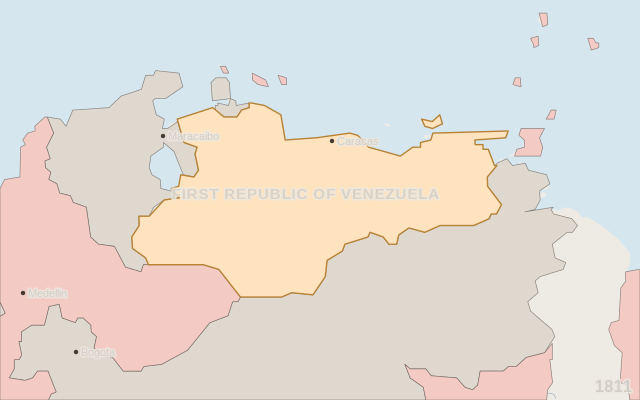
402,000 km²
At its height in 1811 · about the size of Paraguay
3 rulers
the Triumvirate
 Spanish Empire,
 United Provinces of New Granada,
 Portuguese Empire and
 British Empire.How far it reached, year by year: its ground inside the borders Cliopatria draws (CC BY 4.0), measured on an equal-area grid; the map shows it at its largest, with the cities of the year.
The story
Five thousand years, 3000 BCE to 2026; the state in gold.
Its people
One axis for everyone, so you can see who knew whom: the best-known, ordered by birth.
The best-known people the record files under it, by how many Wikipedias write about them.
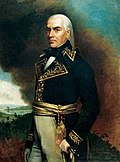 Francisco de Mirandaruler · 1750 – 1816
 Cristóbal Mendozaruler · 1772 – 1829
 Francisco Espejoruler · 1758 – 1814
How it was governed
3 triumvirates on record, 1811 to 1812. Each bar is a reign, as long as it lasted.
Read from the state’s own English article and its rulers’ articles, where Wikidata names no ruler.
| Ruler | Reign | Length | How it ended · source | To the ruler before |
|---|---|---|---|---|
| 19th century · 3 reigns · 1 killed or removed | ||||
| Cristóbal Mendoza | 1811 – 1812 | 1 year | ending not on record | |
| Francisco de Miranda | 1812 – 1812 | under a year | ending not on record | |
| Francisco Espejo | 1812 – 1812 | under a year | executedread from the ruler's own article | |
3 rulers, 3 with terms dated as terms, covering 1811 – 1812. Only 1 years of the line are dated - too short for a median. 0 of 2 handovers irregular - a killing, a deposition, a rival claimant, a rising or a coup beside it. The violent-handover count is withheld: power changed hands so often that any rising falls beside one (exposure 1.00, limit 0.6). A blank in the last column means no kin on record, which is coverage, never “unrelated”.
Each symbol with the years its own statement gives; the timeline flies the one of the year on screen.
 Cristóbal Mendoza1 yrsFrancisco de Miranda0 yrsFrancisco Espejo0 yrs
How it compares
Each column is a share of the states; gold is the First Republic of Venezuela.
Why it fell
Historians still argue. Here is what the atlas records about its last century:
1812
Francisco Espejo, killed in office
3 entries the atlas files under it, all in 1800 – 1899.
“First Republic of Venezuela”, Pastlas, a historical atlas, 2026-11-26. https://app.pastlas.com/state/first-republic-of-venezuela/
Drawn from Wikidata (Q8935, CC0), borders from Cliopatria (CC BY 4.0), coast and rivers from Natural Earth, cities from Reba, Reitsma & Seto 2016 (CC BY 4.0), symbols from Wikimedia Commons, each under its own licence. Data built 2026-11-26 · Pastlas v2.47.1, by Oleh Voronko; the published atlas and its data are for non-commercial use.
Areas are measured on an equal-area grid from borders simplified to about five kilometres. “c.” marks an approximate date, and a date known to the century is never printed to the year. Counts are what the atlas holds, and they follow Wikipedia’s coverage: a busy century is partly a fact about the record.