State · 768 – 969
Principality of Serbia (early medieval)
A state of 768 – 969 — 201 years in Europe. The atlas records 3 things within it — wars and battles 1 · people 2. Its line of rulers holds 11 people, 9 with dated terms. Its own article says it was conquered by Byzantine Empire.
- Wikidata's English label: Principality of Serbia.
For the full story, the article on Wikipedia (CC BY-SA 4.0); this page holds what the record says of the state.
- Stood
- 201 years
- 768 – 969
- Rulers
- 11
- the tsar
- Most ground
- 61,200 km²
- in 922
- Within it
- 3
- recorded rows
- Symbol
- 1
- on record, with years
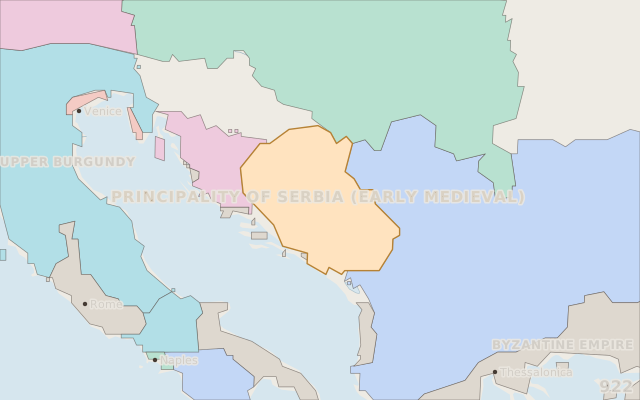
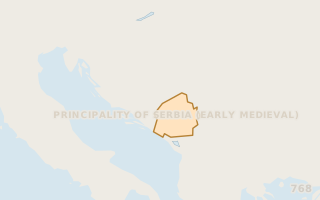
768 · first mapped · 24,300 km²
922 · at its largest · 61,200 km²
Where it sits in time
Five thousand years, 3000 BCE to 2026; the state in gold.
How it ended, as its article says
Conquered by Byzantine Empire, 969. Read from the article's section “lead” by its grammar; the claim is only that the article says so.
The principality was annexed by the Byzantine Empire in c. 969–971 and ruled as the Catepanate of Ras.
One sentence of the English Wikipedia article, CC BY-SA 4.0.
Rulers
The line of tsar.
| Ruler | Reign | Length | How it ended · source | To the ruler before |
|---|---|---|---|---|
| Višeslav of Serbia | 780 – 780 | under a year | ending not on record | |
| Prosigoj of Serbia | 830 – 830 | under a year | ending not on record | grandchild |
| Radoslav of Serbia | 830 – 830 | under a year | ending not on record | parent |
| Mutimir of Serbia | 850 – 891 | 41 years | ending not on record | |
| Pribislav of Serbia | 891 – 892 | 1 year | ending not on record | child |
| Petar of Serbia | 892 – 917 | 25 years | deposed, the article saysread from the ruler's own article | |
| Pavle of Serbia | 917 – 921 | 4 years | ending not on record | |
| Zaharija of Serbia | 921 – 925 | 4 years | ending not on record | |
| Časlav of Serbia | 933 – 943 | 10 years | ending not on record |
11 rulers, 9 with terms dated as terms, covering 780 – 943. Median reign 4 years. 2 of 8 handovers irregular - a killing, a deposition, a rival claimant, a rising or a coup beside it. A blank in the last column means no kin on record, which is coverage, never “unrelated”.
Ground held, by year
km² inside its borders as the borders dataset draws them, measured on an equal-area grid; a step series, held between the years the dataset maps.
24,300 km² in 768, 60,900 km² in 958; at its largest 60,900 km² in 938. Cliopatria, CC BY 4.0.
Flag or arms
Each symbol with the years its own statement gives; the timeline flies the one of the year on screen.

seal, undatedSeal of Strojimir · Public domain
What happened within it, by century
Every row the atlas hosts under this state, by the century it began in: wars and battles in red, risings, regime changes and massacres beside them, everything else in grey. A tall bar is a century the record is full for, which is partly a fact about Wikipedia.
800 – 8993 rows · 1 wars and battles
- Petar of Serbia · person · 870 – 917
- Zaharija of Serbia · politician · 890 – 924
- Siege of Serdica (809) · battle · 809
Among all states
Each measure against the states that carry it, never against all of them: a bar is the share of those states below this one.
- How long it stood201 years
stood longer than 63% of 3,187 states with a recorded end or still standing.
- The most ground it held61,200 km²
held more ground at its peak than 36% of 1,465 states with a border in Cliopatria.
- Wars recorded per centurynone
had more wars on record per century than 44% of 3,187 states, counting the wars the atlas hosts under each.
- How long a reign lasted, at the median4 years
had longer reigns, at the median, than 13% of 967 states whose dated line can carry a median.
- Rulers on record11
has more rulers on record than 83% of 1,968 states with a line of rulers.
Open in the atlas
- On the timeline, 748 – 989, with everything that stood beside it.
- On the map in 922, live: scrub the year and watch its borders move.
- Investigate it: what led to it, what came of it, and its succession analysed.
Wikidata Q13107370 (CC0) · borders Cliopatria, CC BY 4.0 · coast and rivers Natural Earth · symbols from Wikimedia Commons, each credited above · one sentence of the English Wikipedia article, CC BY-SA 4.0 · data built 2026-10-06 · Pastlas v2.9.1, by Oleh Voronko. The published atlas and its data are for non-commercial use.