State · 299 BCE – 580 CE
Kingdom of Iberia
A state of 299 BCE – 580 CE — 879 years in the Middle East and North Africa. It was replaced by Sasanian Iberia. The atlas records 22 things within it — wars and battles 1 · people 21. Its line of rulers holds 42 people, 13 with dated terms. Its own article says it was dissolved by Hormizd IV.
For the full story, the article on Wikipedia (CC BY-SA 4.0); this page holds what the record says of the state.
- Stood
- 879 years
- 299 BCE – 580
- Rulers
- 42
- the King of Iberia
- Most ground
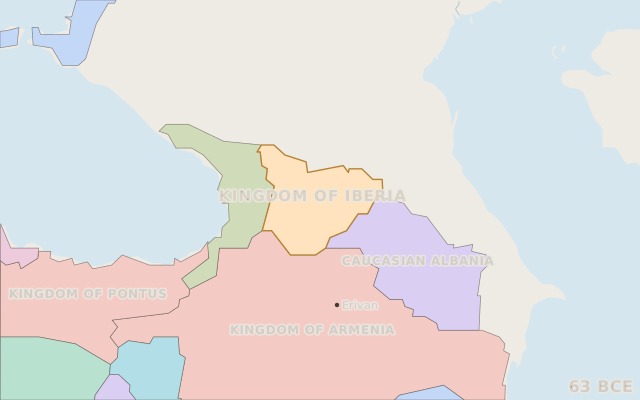
- 35,800 km²
- in 63 BCE
- Within it
- 22
- recorded rows
- Symbol
- 1
- on record, with years
Where it sits in time
Five thousand years, 3000 BCE to 2026; the state in gold.
Before and after
The states the record files it as replacing or following, and those that replaced or followed it - Wikidata's own statements, each read from this state's side.
After it
- Sasanian Iberia · replaced by
How it ended, as its article says
Dissolved by Hormizd IV, 580. Read from the article's section “lead” by its grammar; the claim is only that the article says so.
In 580, king Hormizd IV (578–590) abolished the monarchy after the death of King Bakur III, and Iberia became a Persian province ruled by a marzpan (governor).
One sentence of the English Wikipedia article, CC BY-SA 4.0.
Rulers
The line of King of Iberia.
| Ruler | Reign | Length | How it ended · source | To the ruler before |
|---|---|---|---|---|
| Pharnavaz I | 299 BCE – 234 BCE | 65 years | died in office, manner not recordedread off the dates alone | |
| Sauromaces I | 234 BCE – 159 BCE | 75 years | died in office, manner not recordedread off the dates alone | child |
| Mirian I of Iberia | 159 BCE – 109 BCE | 50 years | died in office, manner not recordedread off the dates alone | |
| Pharnajom | 109 BCE – 90 BCE | 19 years | died in office, manner not recordedread off the dates alone | child |
| Artaxias I of Iberia | 90 BCE – 78 BCE | 12 years | died in office, manner not recordedread off the dates alone | |
| Artoces of Iberia | 78 BCE – 63 BCE | 15 years | died in office, manner not recordedread off the dates alone | child |
| Pharnavaz II | 63 BCE – 32 BCE | 31 years | left office aliveread off the dates alone | child |
| Mirian II | 30 BCE – 20 BCE | 10 years | left office aliveread off the dates alone | |
| Artaxias II of Iberia | 20 BCE – 1 | 21 years | died in office, manner not recordedread off the dates alone | child |
| Pharasmanes I | 1 – 58 | 57 years | died in office, manner not recordedread off the dates alone | |
| Mihrdat I | 58 – 106 | 48 years | left office aliveread off the dates alone | child |
| Amazasp I of Iberia | 106 – 116 | 10 years | died in office, manner not recordedread off the dates alone | sibling |
| Ghadam of Iberia | 132 – 135 | 3 years | died in office, manner not recordedread off the dates alone | grandchild |
42 rulers, 13 with terms dated as terms, covering 299 BCE – 135. Median reign 21 years. 0 of 12 handovers irregular - a killing, a deposition, a rival claimant, a rising or a coup beside it. A blank in the last column means no kin on record, which is coverage, never “unrelated”.
Ground held, by year
km² inside its borders as the borders dataset draws them, measured on an equal-area grid; a step series, held between the years the dataset maps.
35,800 km² in 49 BCE, 35,700 km² in 526; at its largest 35,800 km² in 49 BCE. Cliopatria, CC BY 4.0.
Flag or arms
Each symbol with the years its own statement gives; the timeline flies the one of the year on screen.

flag, undatedKartli - drosha jvari · CC BY-SA 3.0 · Ec.Domnowall (vectorisation SVG)
What happened within it, by century
Every row the atlas hosts under this state, by the century it began in: wars and battles in red, risings, regime changes and massacres beside them, everything else in grey. A tall bar is a century the record is full for, which is partly a fact about Wikipedia.
300 BCE – 201 BCE1 row
- Sauromaces I · ruler · 251 – 159 BCE
200 BCE – 101 BCE3 rows
- Artaxias I of Iberia · ruler · 151 – 78 BCE
- Artoces of Iberia · ruler · 151 – 63 BCE
- Pharnajom · ruler · 151 – 90 BCE
100 BCE – 1 BCE4 rows
- Pharasmanes I · ruler · 51 BCE – 58 CE
- Artaxias II of Iberia · ruler · 2 BCE – 1 CE
- Mirian II · ruler · 89 – 19 BCE
- Pharnavaz II · ruler · 51 – 30 BCE
0 – 992 rows
- Rhadamistus · person · 1 – 58
- Pharasmanes II · ruler · 50 – 132
100 – 1993 rows
- Mihrdat I · ruler · 100 – 200
- Pharasmanes III · ruler · 134 – 185
- Amazasp II · ruler · 101 – 189
200 – 2991 row
- Mirian III · ruler · 265 – 361
300 – 3991 row
- Trdat of Iberia · ruler · 301 – 406
400 – 4992 rows
- Vakhtang I · ruler · 440 – 502
- Pharasmanes IV · ruler · 400 – 409
500 – 5994 rows · 1 wars and battles
- Iberian War · war · 526 – 532
- Bacurius III · ruler · 550 – 580
- Pharasmanes VI · ruler · 510 – 599
- Pharasmanes V · ruler · 520 – 561
Among all states
Each measure against the states that carry it, never against all of them: a bar is the share of those states below this one.
- How long it stood879 years
stood longer than 96% of 3,187 states with a recorded end or still standing.
- The most ground it held35,800 km²
held more ground at its peak than 30% of 1,465 states with a border in Cliopatria.
- Wars recorded per century0.1
had more wars on record per century than 89% of 3,187 states, counting the wars the atlas hosts under each.
- How long a reign lasted, at the median21 years
had longer reigns, at the median, than 66% of 967 states whose dated line can carry a median.
- Rulers on record42
has more rulers on record than 96% of 1,968 states with a line of rulers.
What led to it, and what came of it
The investigation's own picture: 0 causes the record names and 1 result, the strongest six of each at their own years, joined to the state by the kind of claim - a recorded statement solid, the article's sentence dashed, a theory dash-dot.
Open the investigation: every row with its evidence, the conditions at the time, the theories condition by condition, and the succession analysed.
Open in the atlas
- On the timeline, 387 BCE – 668, with everything that stood beside it.
- On the map in 63 BCE, live: scrub the year and watch its borders move.
- Investigate it: what led to it, what came of it, and its succession analysed.
Wikidata Q19083 (CC0) · borders Cliopatria, CC BY 4.0 · coast and rivers Natural Earth · symbols from Wikimedia Commons, each credited above · one sentence of the English Wikipedia article, CC BY-SA 4.0 · data built 2026-10-06 · Pastlas v2.9.1, by Oleh Voronko. The published atlas and its data are for non-commercial use.