State · 1395 – 1797
Duchy of Milan
A state of 1395 – 1797 — 402 years in Europe. It replaced Cisalpine Republic and followed Golden Ambrosian Republic. It was followed by Transpadane Republic and province of Milan. The atlas records 28 things within it — wars and battles 10 · treaties 1 · people 17. Its line of rulers holds 10 people, 9 with dated terms. Its own article says it was dissolved.
For the full story, the article on Wikipedia (CC BY-SA 4.0); this page holds what the record says of the state.
- Stood
- 402 years
- 1395 – 1797
- Rulers
- 10
- the Duke of Milan
- Most ground
- 42,700 km²
- in 1422
- Within it
- 28
- recorded rows
- Symbols
- 3
- on record, with years
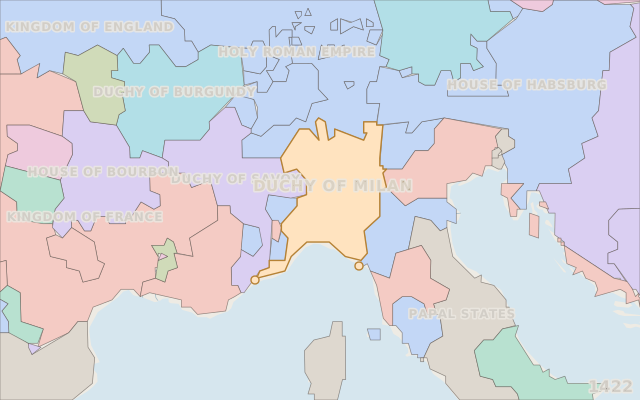
1422 · at its largest · 42,700 km²
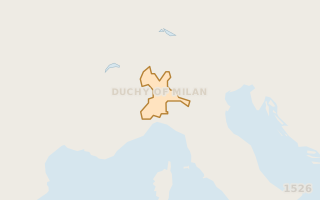
1526 · last mapped · 17,500 km²
Where it sits in time
Five thousand years, 3000 BCE to 2026; the state in gold, what it replaced or followed and what replaced or followed it in grey.
Before and after
The states the record files it as replacing or following, and those that replaced or followed it - Wikidata's own statements, each read from this state's side.
Before it
- Golden Ambrosian Republic · follows · 1447 – 1450
- Cisalpine Republic · replaces · 1797 – 1802
After it
- province of Milan · followed by
- Transpadane Republic · followed by · 1796 – 1797
How it ended, as its article says
Dissolved, 1796. Read from the article's section “lead” by its grammar; the claim is only that the article says so.
The duchy remained an Austrian possession until 1796 when a French army under Napoleon Bonaparte captured it in the War of the First Coalition, and it ceased to exist a year later as a result of the Treaty of Campo Formio, when Austria ceded it to the new Cisalpine Republic.
One sentence of the English Wikipedia article, CC BY-SA 4.0.
Rulers
The line of Duke of Milan - the office this state names as its head of state.
| Ruler | Reign | Length | How it ended · source | To the ruler before |
|---|---|---|---|---|
| Gian Galeazzo Visconti | 1395 – 1402 | 7 years | died in office of natural causesWikidata's manner of death | |
| Gian Maria Visconti | 1402 – 1412 | 10 years | killedWikidata's manner of death | child |
| Filippo Maria Visconti | 1412 – 1447 | 35 years | died in office, manner not recordedread off the dates alone | sibling |
| Francesco I Sforza | 1450 – 1466 | 16 years | died in office of natural causesWikidata's manner of death | in-law |
| Galeazzo Maria Sforza | 1466 – 1477 | 11 years | killedWikidata's manner of death | child |
| Gian Galeazzo Sforza | 1476 – 1494 | 18 years | killed, the article saysread from the ruler's own article | child |
| Ludovico Sforza | 1494 – 1500 | 6 years | left office aliveread off the dates alone | nephew or niece |
| Maximilian Sforza | 1512 – 1515 | 3 years | left office aliveread off the dates alone | child |
| Francesco II Sforza | 1521 – 1535 | 14 years | died in office, manner not recordedread off the dates alone | sibling |
10 rulers, 9 with terms dated as terms, covering 1395 – 1535. Median reign 11 years. 3 of 8 handovers irregular - a killing, a deposition, a rival claimant, a rising or a coup beside it. A blank in the last column means no kin on record, which is coverage, never “unrelated”.
Ground held, by year
km² inside its borders as the borders dataset draws them, measured on an equal-area grid; a step series, held between the years the dataset maps.
37,300 km² in 1420, 35,200 km² in 1495; at its largest 37,300 km² in 1420. Cliopatria, CC BY 4.0.
Flags and arms, in order
Each symbol with the years its own statement gives; the timeline flies the one of the year on screen.
.svg/120px-Coat_of_arms_of_the_Duchy_of_Milan_(Sforza_period).svg.png)
coat of arms, undatedCoat of arms of the Duchy of Milan (Sforza period) · CC BY-SA 4.0 · MostEpic .svg/120px-Coat_of_Arms_of_Louis_XII_(Milan).svg.png)
coat of arms, undatedCoat of Arms of Louis XII (Milan) · CC BY-SA 4.0 · Facquis .svg/120px-Flag_of_the_Duchy_of_Milan_(1450).svg.png)
flag, undatedFlag of the Duchy of Milan (1450) · Public domain
What happened within it, by century
Every row the atlas hosts under this state, by the century it began in: wars and battles in red, risings, regime changes and massacres beside them, everything else in grey. A tall bar is a century the record is full for, which is partly a fact about Wikipedia.
1300 – 13993 rows
- Gian Galeazzo Visconti · ruler · 1351 – 1402
- Filippo Maria Visconti · ruler · 1392 – 1447
- Gian Maria Visconti · ruler · 1388 – 1412
1400 – 149915 rows · 5 wars and battles
- Ludovico Sforza · ruler · 1452 – 1508
- Francesco I Sforza · ruler · 1401 – 1466
- Gian Galeazzo Sforza · ruler · 1469 – 1494
- Galeazzo Maria Sforza · ruler · 1444 – 1477
- Maximilian Sforza · ruler · 1493 – 1530
- Paolo Giovio · religious leader · 1483 – 1552
- Francesco II Sforza · ruler · 1495 – 1535
- Alfonso I d'Este · commander · 1476 – 1534
and 7 more in the atlas.
1500 – 15997 rows · 4 wars and battles
- Caravaggio · artist · 1571 – 1610
- Gerolamo Cardano · inventor · 1501 – 1576
- Pope Gregory XIV · politician · 1535 – 1591
- Battle of Pavia · battle · 1525
- Battle of Bicocca · battle · 1522
- Battle of Novara · battle · 1500
- Battle of Landriano · battle · 1529
1600 – 16991 row · 1 wars and battles
- Battle of Tornavento · battle · 1636
1700 – 17992 rows
- Alessandro Volta · inventor · 1745 – 1827
- Cesare Beccaria · philosopher · 1738 – 1794
Among all states
Each measure against the states that carry it, never against all of them: a bar is the share of those states below this one.
- How long it stood402 years
stood longer than 81% of 3,187 states with a recorded end or still standing.
- The most ground it held42,700 km²
held more ground at its peak than 32% of 1,465 states with a border in Cliopatria.
- Wars recorded per century0.2
had more wars on record per century than 90% of 3,187 states, counting the wars the atlas hosts under each.
- How long a reign lasted, at the median11 years
had longer reigns, at the median, than 38% of 967 states whose dated line can carry a median.
- Rulers on record10
has more rulers on record than 80% of 1,968 states with a line of rulers.
What led to it, and what came of it
The investigation's own picture: 0 causes the record names and 2 results, the strongest six of each at their own years, joined to the state by the kind of claim - a recorded statement solid, the article's sentence dashed, a theory dash-dot.
Open the investigation: every row with its evidence, the conditions at the time, the theories condition by condition, and the succession analysed.
Open in the atlas
- On the timeline, 1355 – 1837, with everything that stood beside it.
- On the map in 1422, live: scrub the year and watch its borders move.
- Investigate it: what led to it, what came of it, and its succession analysed.
Wikidata Q153529 (CC0) · borders Cliopatria, CC BY 4.0 · coast and rivers Natural Earth · symbols from Wikimedia Commons, each credited above · one sentence of the English Wikipedia article, CC BY-SA 4.0 · data built 2026-10-06 · Pastlas v2.9.1, by Oleh Voronko. The published atlas and its data are for non-commercial use.